Commercial site clearance is the job of stripping back overgrowth, tidying frontages, and clearing vegetation across a business premises so the site stays safe, accessible, and presentable. This post walks through what that kind of job actually involves, why a factory or industrial unit brings in an insured contractor rather than leaning on its own staff, and how the work differs from a domestic garden clear-out.
TL;DR
- Commercial site clearance covers overgrowth, verges, car parks, frontages, vegetation management, and full waste removal.
- Businesses use an insured contractor for the safety cover, the right machinery, licensed waste disposal, and minimal disruption to trading.
- Industrial jobs are bigger, harder to access, and heavier on health and safety than a domestic garden.
- A factory site can need a mix of one-off clearances and a scheduled maintenance round.
- Pricing depends on site size, access, waste volume, and whether it is a single visit or a contract.
What commercial and industrial grounds work actually involves
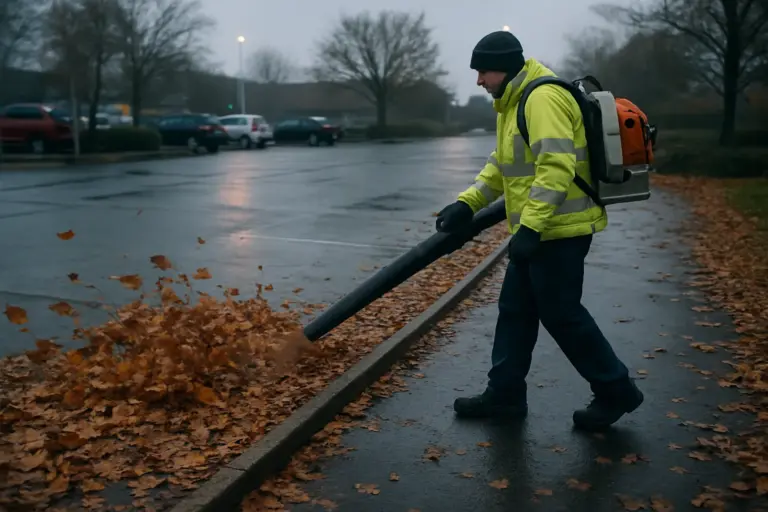
On a factory or industrial unit, the grounds are rarely a manicured garden. They are the bits around the edges: verges along the access road, the strip between the fence line and the building, the car park islands, the loading bay approach, and the frontage that faces the street. Left alone, these areas go wild fast. Bramble creeps over palisade fencing, self-seeded saplings push up through kerb joints, and knee-high weeds swallow the signage.
A typical clearance job pulls all of that back to a manageable state. A factory clearance can run across several fronts at once:
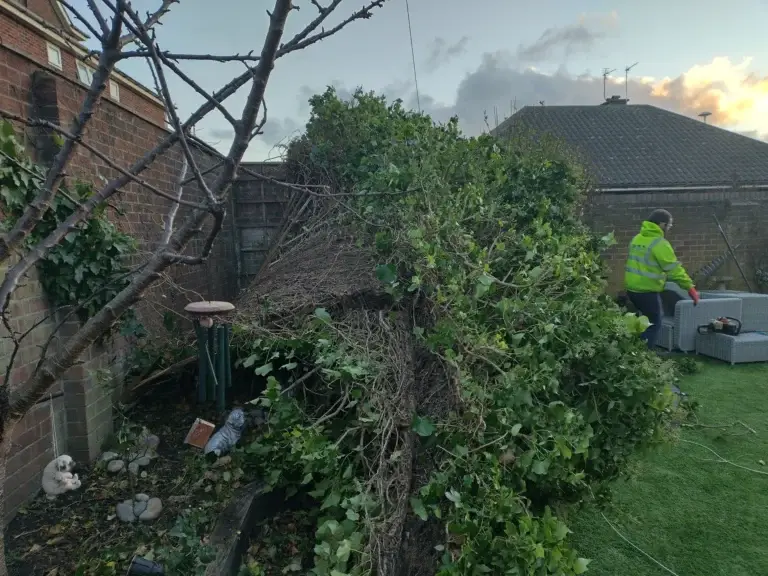
- Overgrowth clearance — cutting back brambles, nettles, and rank grass that had taken over the boundary and verges.
- Frontage and kerbside tidying — clearing the street-facing edge so the unit looked cared for rather than abandoned.
- Vegetation management — pulling back growth from fencing, gates, and around signage so the site reads as secure and open for business.
- Car park and access — clearing weeds from surfacing and edges so bays, markings, and turning space stay usable.
- Waste removal — everything cut, raked, and loaded straight into the tipper and taken off site for licensed disposal.
That last point matters more than people expect. Cutting the growth is half the job. Getting the green waste, brash, and general debris off site legally is the other half, and it is where the tipper truck earns its keep.
Why businesses bring in an insured contractor instead of using staff
It can be tempting to hand a strimmer to whoever is free that afternoon. It rarely works out cheaper, and it carries risk the business does not need to take on. Here is why the maintenance staff route falls down.
Safety and insurance sit with us, not you
Clearing overgrowth near fencing, traffic, and machinery is not risk-free work. A qualified contractor turns up with public liability cover, method statements, and trained operators. If something goes wrong, the liability sits with the contractor, not with your business or a member of your team who was never trained for it.
The right kit is already on the truck
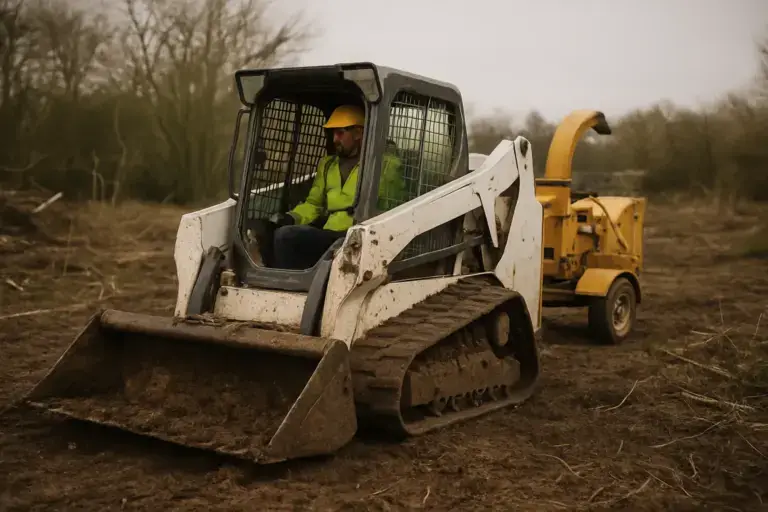
Industrial overgrowth eats consumer-grade tools. Professional brushcutters, chippers, and a tipper for haulage make short work of a job that would take your staff days with a hedge trimmer and a wheelbarrow. Our professional fleet includes skid steers, chippers and ride-on mowers, so the right kit can be on site for the job.
Waste goes to a licensed tip
Green and mixed waste from a commercial site is business waste, and it has to be disposed of properly with the right documentation. Check your contractor is a registered waste carrier, and ask what paperwork you will get. Fly-tipping or informal disposal is a fine waiting to happen, and it lands on the business that produced the waste.
Minimal disruption to trading
A good contractor works around your operation, not through the middle of it. We can schedule work around your site requirements to minimise disruption, including evenings or weekends by prior arrangement.
Worth knowing: the same checks you would run on a tree surgeon apply to any commercial grounds contractor — insurance, qualifications, and proof of licensed waste disposal. Our guide on how to choose a tree surgeon in Sunderland covers exactly what to ask before you hand over a site.
How a factory job differs from a domestic garden
People assume factory grounds clearance is just a big garden. It is not. Four things change the moment you drive onto an industrial site.
- Scale — you are clearing acres of boundary and hardstanding, not a back lawn. That shifts the whole approach to machinery and manpower.
- Access — parked HGVs, live loading bays, palisade fencing, and locked gates all shape how and when the work gets done.
- Health and safety — vehicle movements, forklifts, and site rules mean risk assessments and, on some sites, inductions before a single strimmer starts.
- Scheduling — the site is trading. The work fits around production, not the other way round, which often means early starts or planned windows.
Typical services a commercial site needs
A site can need a one-off reset followed by a regular round. Common jobs include:
- Full overgrowth and site clearance to reset a neglected premises.
- Scheduled grounds maintenance — verges, frontages, and car park edges kept in check across the year.
- Vegetation control along fence lines and boundaries for security and sightlines.
- Seasonal cutbacks before an inspection, audit, or client visit.
- Reactive clearance after storms or fast summer growth.
How pricing and contracts work
A one-off clearance is usually priced per visit, based on site size, access, the volume of waste to remove, and how heavy the overgrowth has got. A site that has been left for two years costs more than one cut back last autumn, because there is simply more to clear and haul away.
Ongoing grounds maintenance tends to work better as a contract — a fixed schedule of visits across the year at an agreed rate. That gives you a predictable cost line, keeps the site permanently presentable, and stops the growth ever getting back to the state that needs a full reset. For factories with a customer-facing frontage or regular audits, a maintenance contract is worth pricing against repeated one-off resets. Ask for both to be quoted so you can see the trade-off before you commit.
Get a commercial quote for your site
DB Tree & Garden Services handles commercial site clearance and grounds maintenance for factories, industrial units, and business premises across Sunderland, Durham, Washington, Seaham, and Newcastle — fully insured, with NPTC & LANTRA certified operators. Send us your site details or book a visit and we will give you a free, no-obligation commercial quote.
Frequently Asked Questions
How long does a typical factory site clearance take?
It depends on the size of the grounds and how overgrown they are. After a site visit, the written quote sets out scope and timescales.
Can you work around our business operating normally?
Yes, we can schedule work to minimise disruption, including evenings or weekends by prior arrangement. Tell us your constraints when you enquire and we’ll plan around them.
What happens to all the waste we’ve cleared?
We remove arisings and dispose of materials responsibly in line with UK waste management regulations. Fly-tipping is never an option for anyone.
Do you offer one-off clearances or ongoing maintenance contracts?
Both. We provide one-off visits and ongoing maintenance contracts, with scheduled visits that can be weekly, fortnightly or monthly.
Why shouldn’t we just ask our maintenance team to do this?
Grounds work near traffic and machinery carries risk, and staff may not have the training or kit for heavy growth removal. We’re fully insured, our operators are NPTC and LANTRA certified, and RAMS can be provided on request.