Two quotes land on the same clearance job, and one of them is a lot cheaper. That’s usually where the decision gets made, on the number at the bottom, before anyone’s worked out what each quote is actually for. A self-drive quote gets you a machine on a trailer and a set of keys. Not much more. Operated plant hire gets you the machine and someone trained to run it, and those aren’t the same product wearing two price tags. Treat them as interchangeable and a straightforward job in Sunderland or Washington turns into a second day, a clipped drain run, or an insurer asking questions. This is for site managers, contractors, farmers and landowners weighing a self-drive quote against ours: what you’re paying for, who carries the risk, and how to match the machine to the ground you’ve actually got.
TL;DR
- Self-drive hires you a machine. Operated plant hire hires you a machine and a trained operator, and the two carry very different risk.
- Regulation 9 of PUWER 1998 makes every employer ensure that anyone using work equipment at work has had adequate training. On a self-drive hire, that employer is usually you.
- DB Tree & Garden supplies operated hire only. Skid steer loader, tracked wood chipper and brush mower, with full public liability insurance, risk assessments and method statements supplied for every hire.
- Self-drive day rates rarely include transport both ways, the time spent learning the controls, or the second day when the ground turns out worse than the quote assumed.
- Access and ground conditions decide which one you actually need, not the day rate. Get that wrong and the cheap option becomes the expensive one.
What operated plant hire actually gets you
A self-drive hire is exactly what it sounds like: a machine turns up, you get a quick walk-round from the delivery driver, and after that it’s yours to operate until it goes back. The hire firm’s obligation mostly stops at the kerb. Fuel, transport at each end, and whoever ends up on the controls are down to you.
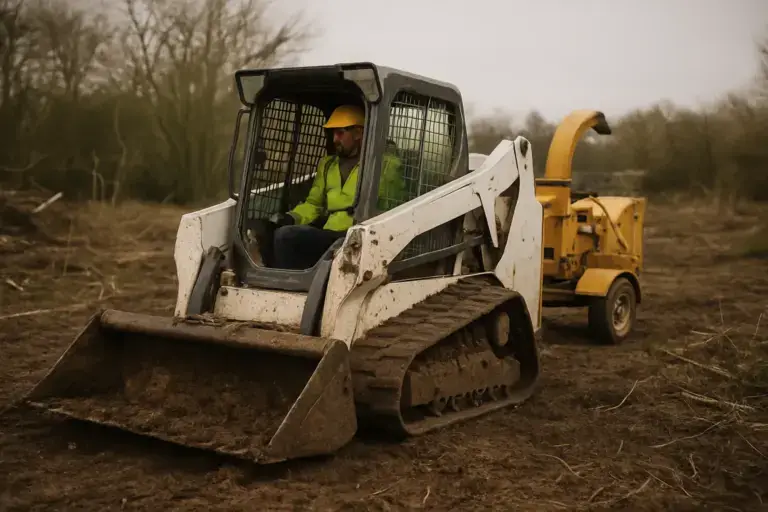
Operated plant hire is a different arrangement. DB Tree & Garden supplies operated hire only: a skid steer loader, tracked wood chipper or brush mower, delivered with one of our own trained operators, run to a job you’ve briefed us on rather than handed over and walked away from. We carry the insurance for the work being carried out, not just the machine sat on your drive. It’s plant hire with operator in the fullest sense: the operator is the point of it, not an add-on.
We don’t do self-drive. This post isn’t trying to talk you out of it in every case either, and there are jobs where a self-drive skid steer from a plant firm down the road is the sensible, cheaper call. What follows is how to tell which kind of job you’ve actually got. Our machine hire page covers what we offer if you want the short version first.
The competence question: who’s actually trained to run it
Regulation 9 of the Provision and Use of Work Equipment Regulations 1998 puts this in plain terms: every employer has to ensure that anyone using work equipment has received adequate training for health and safety, covering the methods for using it, the risks it involves, and the precautions to take. HSE’s guidance on that regulation adds that there’s a similar duty to make sure supervisory and managerial staff are adequately trained too, and that what counts as “adequate” varies with the job, the worker’s existing competence, the equipment, and how much supervision is actually happening on site.
None of that goes away because the machine came from a hire firm rather than off your own yard. PUWER bites on work equipment used at work, so on a job rather than your own back garden, the duty doesn’t move when you put your own team on a self-drive skid steer. You’re the employer Regulation 9 means, or yours is. A five-minute handover from a delivery driver isn’t training in any sense HSE’s guidance describes, and it’s rarely the delivery driver’s job to check whether the person signing for the machine has run one before.
With operated hire, that question doesn’t land on you. Our operators are NPTC and LANTRA qualified, and the competence sits with us before the machine ever reaches your site.
Who carries the risk when the machine clips something
Self-drive hire agreements are usually clear about this, if you read the small print: while the machine’s in your hands, you’re generally the one answering for the damage it causes, to the site, to a boundary wall, to a buried service nobody flagged. Cover for the hired machine itself and public liability cover for what the machine does are two different products, and a hire agreement doesn’t always arrange both. Work out which one you’ve actually got before the low-loader turns up, not after.
Operated hire changes where that sits. DB Tree & Garden carries full public liability insurance for the work our operators carry out, so if our operator causes damage on your site, it’s our cover that answers for it rather than yours. That’s worth more on a commercial job in Durham or Newcastle than it sounds on paper. It’s the difference between a phone call to us and a phone call to your own insurer.
The hidden costs a self-drive day rate doesn’t show you
A self-drive day rate looks like the whole number right up until the job’s actually running. Then three things tend to show up that weren’t on the quote:
- Transport at both ends. A low-loader booking to collect and return the machine adds up fast if the depot’s not local.
- The learning curve. An hour or two spent working out the controls on a machine you’ve never sat in, done at the pace of someone being careful rather than someone who does it daily.
- The second day. Ground that looked firm from the gate turns out soft once the machine’s loaded, or the job’s bigger than it looked in photos, and a one-day hire becomes two.
Add the second day’s rate, the second day’s fuel, and the second low-loader run, and the gap to an operated quote closes fast, sometimes past it.
Rule of thumb: if the job needs more than a day, the ground’s untested, or nobody on your team has run the machine before, operated hire usually works out cheaper once you price in the second day and the learning curve properly. Self-drive earns its lower rate on short jobs with easy access and someone who already knows the controls.
Matching the machine to the job
Three machines cover most of what we’re asked for. The skid steer loader handles moving soil, rubble, timber and aggregates, clearing vegetation, and levelling ground as prep for whatever comes next. It’s compact enough for tight access, which is where plenty of North East sites fall down before the work even starts.
The tracked wood chipper takes brash, branches, hedge cuttings and timber sections within safe operating limits. We can chip on site to cut the volume down, then either leave the chip for reuse where that suits the job or remove and dispose of it as part of the quote. It follows the job. It doesn’t start one.
The brush mower is the one for heavy growth: rough ground, long grass, brambles, land that’s been left long enough that nobody can see what’s underneath it. It resets an overgrown site so the other two have something to work with.
None of them is the right call for everything, and anyone hiring you a skid steer in the North East should tell you plainly if your job’s better suited to something else. If you’re not sure which one fits, describe the job and we’ll tell you straight, even if that means pointing you at self-drive instead.
Access and ground conditions decide everything
This is the question that actually decides the job, and it’s the one that can’t be answered over the phone. Photos lie. A machine that fits the gate you measured is no use if the real gap on site is narrower, and ground that looks firm in a photo can bog a tracked machine down within the hour, turning a half-day job into a recovery job.
We look at access and ground conditions before we quote, not after we’ve turned up. That’s not caution for its own sake. It’s the single biggest variable in whether operated hire or self-drive makes sense for your job, bigger than the machine itself. A site with good access and firm ground might not need operated hire at all. A tight, wet, or awkward one usually does, whatever the day rate says.
RAMS, insurance and site paperwork
Commercial sites usually want more than a machine and an operator; they want it on paper. We supply full public liability insurance, risk assessments and method statements for our hire and site work, and where a site runs its own RAMS or induction process, we’ll align our approach with it rather than turn up with our own version and expect it to be accepted.
That matters more on larger jobs. Our large-scale site clearance work for developers and contractors runs to the same standard, and operated machinery hire is usually part of that job rather than a separate booking. If your site has a specific induction pack, tell us before the day, not on it.
Not sure which hire is right for your site?
If you’ve read this far because two quotes don’t match and you’re not sure why, that’s normally the access question, the training question, or both. Not one supplier padding the price. Tell us what the job is, roughly what the ground’s like, and how long you think it’ll take. We’ll give you a straight answer: whether operated hire is worth it for your site, or whether a self-drive skid steer down the road would do the job just as well. Our overview of operated machinery hire across Sunderland and the North East covers the wider service if you want the fuller picture before you call.
Frequently Asked Questions
Is operated plant hire more expensive than self-drive?
Per hour, usually yes. Per job, not always. Self-drive’s lower day rate doesn’t include transport both ways, the time spent learning the controls, or a second day if the ground turns out harder than expected. Price both properly, including what you’d lose if it goes wrong, before deciding on the day rate alone.
Do I need training to hire a self-drive skid steer?
Regulation 9 of the Provision and Use of Work Equipment Regulations 1998 puts a duty on every employer to ensure anyone using work equipment has had adequate training, and PUWER applies to equipment used at work. A quick handover isn’t training. A hire firm’s walk-round on delivery day is unlikely to meet the standard HSE’s guidance describes. Check your own position, or your employer’s, against that guidance before you sign for a self-drive machine.
What happens if a hired machine damages something on site?
On a self-drive hire, that generally falls to whoever’s operating it, under the terms of the agreement you signed. Read that agreement. Check whether it arranges public liability cover or only cover for the machine itself, because they aren’t the same thing. With DB Tree & Garden’s operated hire, our own public liability insurance covers the work our operators carry out, so damage caused by our operator is answered by our cover rather than yours.
Can DB Tree & Garden work to our site’s RAMS or induction process?
Yes. We supply our own risk assessments and method statements as standard, and where a commercial site runs its own RAMS or induction requirements, we’ll align our approach with them rather than ask you to adapt to ours.
What machines does DB Tree & Garden offer for operated hire?
A skid steer loader for moving soil, rubble, timber and aggregates, clearing vegetation and levelling ground; a tracked wood chipper for brash, branches, hedge cuttings and timber sections within safe operating limits; and a brush mower for rough ground, long grass, brambles and unmanaged land. Our machine hire page lists the current range. We supply operated hire only, with one of our own trained operators on every job.
DB Tree & Garden provides free no-obligation quotes across Sunderland, Washington, Houghton le Spring and the wider North East. We’re fully insured, NPTC and LANTRA qualified, and we’ll give you a straight answer about which kind of hire your job actually needs, and what it will cost, before any work starts.
Get a free no-obligation quote for local, fully insured tree surgery & garden services across Sunderland and the North East.