It’s mid-afternoon in July and your back room has gone dark. Next door’s leylandii is north of six metres, the sun drops behind it by two o’clock, and you’ve been rehearsing a conversation in your head for a year. Or you’re the other one: you inherited the hedge with the house, you know it’s too big, and you’d rather sort it than get a complaint letter. This is for both of you. Here’s the order these get settled in, what you can do on your own side, and what the work costs.
TL;DR
- Leylandii won’t regrow from bare brown wood. A hard cut is one-way: reduce to a height you can keep, or take it out.
- Growth crossing onto your land is generally cut back to the boundary line, no further. The cuttings stay the owner’s property.
- The council’s high hedge route carries a fee, can be slow, and only ever gets a hedge reduced. Never removed.
- A hedge run is quoted after a visit.
- Nesting birds are protected roughly March to August, your side included.
Why leylandii causes more boundary rows than anything else
Leyland cypress was sold for decades as the quick privacy screen, and it does that well at first. Then it keeps going. Left alone it doesn’t stop at fence height, or at six metres; it heads for full tree size and widens as it goes.
A screen planted in the nineties, cut off a stepladder for a few years, then left until you’re reducing a row of trees rather than trimming a hedge.
The brown wood problem, and why it forces a choice
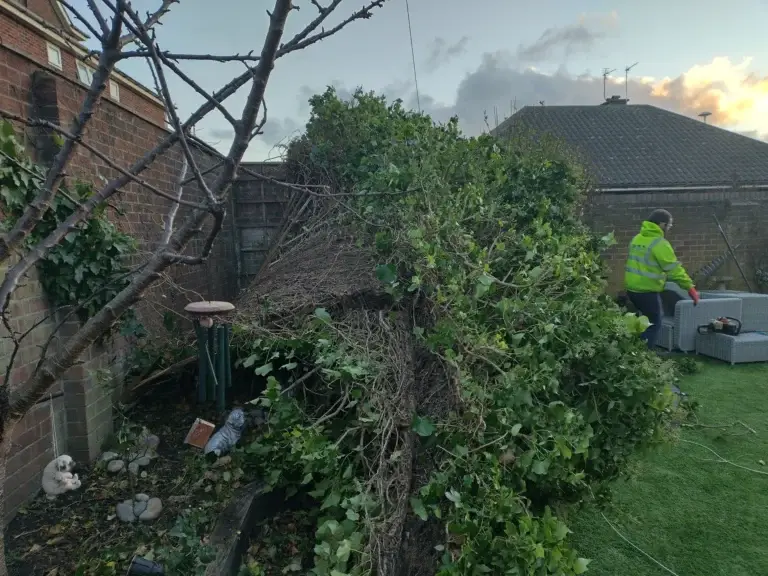
Cut a leylandii back into the bare brown wood inside the hedge and it will not green up again. There are almost no dormant buds in there to push new growth. Beech, hornbeam and laurel forgive a hard cut and reshoot. This one doesn’t.
So the green skin outside is all you have to work with. Take height off the top and the cut face softens over a few seasons as side growth covers it. Go past the green on the flanks and it stays brown. For good.
That’s the fork in the road. Either it comes down to a height you can maintain, or it comes out. Nobody should cut one hard into old wood and promise it’ll recover. It won’t.
What you can do on your own side
The position most people rely on is the common-law one: growth crossing the boundary onto your land can be cut back to the line, and no further. The line, not your best guess at it.
Three things catch people out. The cuttings stay the owner’s property, so offer them back rather than lob them over. You can’t go onto their land uninvited. And height isn’t yours to take, because the top isn’t overhanging your garden.
Timing applies on your side as much as theirs. Nesting birds are protected under the Wildlife and Countryside Act 1981, and a dense evergreen is a favourite nest site, so the March to August window matters. More in hedge cutting and the law and the best time to cut back trees and hedges.
Talk first. Then put it in writing.
A lot of these can be settled here, and it’s the step people skip. Knock on. Say what you’re actually losing (the light in one room after two, a washing line that never dries) rather than how tall their hedge is.
If that goes nowhere, follow it with a note. Short, civil, specific: the height you’d like it brought to, why, a fair timeframe, and an offer to share the cost. It gives them something to say yes to, and a record that you tried if this reaches the council.
And if you own the hedge, get a price before you get defensive.
The council route, and what it can actually get you
If both of those fail, there’s a formal route. The High Hedges provisions of the Anti-social Behaviour Act 2003 let a council deal with complaints about a hedge that’s evergreen or semi-evergreen, a line of two or more trees or shrubs, over two metres tall, and blocking the reasonable enjoyment of light to a home or garden. Leylandii is the classic example.
Three things first. Councils charge a fee and the amount is set locally, so ask Sunderland City Council what theirs is. It can be slow. And they’ll expect to see you tried to settle it yourselves.
The outcome is the part people don’t expect. If a complaint succeeds, the remedy is a notice to cut the hedge back and keep it there. It can’t require removal. The notice names the height needed to fix the problem, and it can’t require the hedge to be cut below two metres. If you want it gone, this was never the route. We’re tree surgeons, not solicitors, so get the detail from the council.
Rule of thumb: a conversation and a written note settle more of these than a complaint form. The formal route costs money, can be slow, and ends in a reduction at best. Reach for it last.
The four realistic options, and what drives the price
Once a decision’s made, the work takes one of four shapes:
- Staged reduction. Down in steps over two or three seasons. Kinder to the hedge, and it spreads the cost.
- Reduce and maintain. Cut to an agreed height and width, then held there once or twice a year. The one that keeps neighbours talking.
- Full removal plus stump grinding. The run comes out, the stumps get ground out, and you can fence, turf or plant the strip.
- Remove and replace. Swap it for a species that takes a cut: yew, beech or hornbeam. You lose the screen for a few years.
On cost, the honest version. Stump grinding cost depends on diameter, access and root plate, and the guide compares it with digging out in stump grinding vs stump removal. A hedge run is quoted after a visit: length, finished height, room to chip the arisings, and how much waste leaves in the truck.
Where a leylandii has stopped being a hedge and is genuinely a tree, it is priced as tree removal, after a visit.
Get a straight answer before anyone falls out
Getting a tree surgeon out early turns an argument about a hedge into a decision about a job. A good tree surgeon can tell you how it’ll look after a reduction and whether the green will hold at the height you want. Inviting both households to the visit, and sharing the quote, gives you something concrete to agree on. It’s all covered under our tree surgery and hedge work.
Frequently Asked Questions
How much does it cost to remove a leylandii hedge?
We price a hedge run after a visit. No two are alike. Length, finished height, access for the kit and waste volume all move the number. Where the hedge has grown into proper trees, it’s priced as tree removal.
Can I cut my neighbour’s leylandii back to the fence myself?
The position most people rely on is the common-law one: growth crossing onto your land can be cut back to the boundary line and no further. That means working from your own side, not stepping into their garden, and not taking height off the top. The cuttings stay theirs, so offer them back. Mind the nesting season, and check with the council if a TPO or conservation area is involved.
Is there a legal height limit for a leylandii hedge?
No. The two-metre figure comes from the High Hedges provisions of the Anti-social Behaviour Act 2003, and it’s the reference point for whether a council will look at a complaint about light, not a cap on height. A complaint that succeeds leads to a reduction, not a removal. Ask Sunderland City Council how the process runs locally.
Will leylandii grow back if we cut it hard?
Not from the brown wood, no. There are almost no dormant buds in the old wood, so anything cut past the green stays bare. Height is different: taking the top out leaves a cut face that side growth gradually covers, which is why a staged reduction beats one hard hit. If the flanks are already brown, replant with something that reshoots.
DB Tree & Garden provides free no-obligation quotes across Sunderland, Washington, Durham, Seaham and the wider North East. We’re fully insured, NPTC and LANTRA qualified, and we’ll send a clear written quote.
Get a free no-obligation quote for local, fully insured tree surgery & garden services across Sunderland and the North East.