If your grounds contractor’s last invoice landed in September and you haven’t seen them since, you’re not imagining it. Grass stops growing through a North East winter, so a grounds maintenance contract can quietly stop with it, and the site doesn’t. Leaves keep falling into December. Rain sits where the ground can’t take it. A gully blocks, a path goes green with moss, and the gap in your winter grounds maintenance is the one nobody notices until somebody’s on the floor by a fire exit. This is for facilities managers, property managers and housing association officers renewing a grounds contract for the season ahead, or wondering why theirs has gone quiet: what winter grounds maintenance should still cover between October and March, what the law actually says about the risk you’re carrying, and what to get in writing before you sign anything.
TL;DR
- Winter doesn’t stop the site: leaf fall, standing water, moss and blocked gullies keep moving until spring, and a mowing-season contract that goes quiet from October is leaving all of it unmanaged.
- You owe anyone using the site the common duty of care under the Occupiers’ Liability Act 1957, and a banked, wet leaf pile by a fire exit sits squarely inside that duty.
- Winter is the best time to get trees checked. A bare crown shows deadwood, cracks and hung limbs that leaf cover hides the rest of the year.
- A written winter schedule should name a visit frequency, say what happens to the arisings, and give you a photo record and one point of contact, not “as required”.
- We won’t print a guaranteed storm response time on a blog page. Agree it in the contract, for your site, alongside a named contact who actually picks up.
Winter grounds maintenance doesn’t stop when the grass does
Some grounds contracts are built around the growing season. Mow, strim, edge, repeat, April to October. Once the grass stops needing a cut, some contractors quietly scale back their visits. The site doesn’t stop generating problems just because nobody’s cutting the lawn.
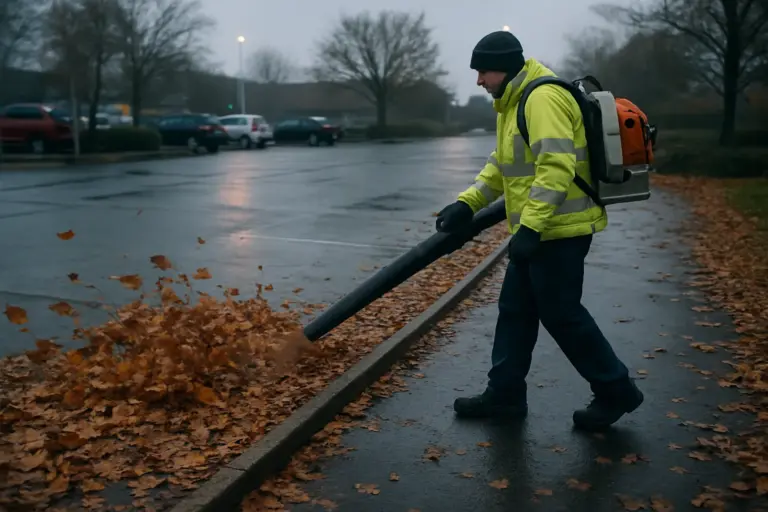
Leaf fall is the obvious one, and it can run later than people plan for. Then it rains. Left alone, leaves bank up against kerbs, block gullies and drains, and turn to a slick mat on anything paved.
Standing water follows the same pattern. A blocked gully on a car park or access road doesn’t dry out between visits in winter the way it might in July. It sits, floods the low corner, and freezes on the nights it’s cold enough. Moss builds on shaded paved routes and north-facing steps, anywhere that doesn’t dry between one wet week and the next. Wind does its own damage too: a loose branch, a fence panel down, debris blown across a delivery route. None of that waits for spring.
The slip and trip risk you’re carrying, October to March
If your site is open to staff, tenants, customers or delivery drivers, you owe them what the law calls the common duty of care. Under section 2(2) of the Occupiers’ Liability Act 1957, that is “a duty to take such care as in all the circumstances of the case is reasonable to see that the visitor will be reasonably safe in using the premises for the purposes for which he is invited or permitted by the occupier to be there.” A banked, wet leaf pile across the main path to your entrance, or a green, mossy step nobody’s treated since October, sits squarely inside that duty. It doesn’t need to be dramatic to be a claim. It just needs to be foreseeable and left.
What the guidance actually asks for
The Health and Safety Executive’s guidance on preventing slips and trips doesn’t talk about weather luck. It builds trip prevention on three things: walkways, housekeeping, and design and maintenance. Are the routes in the right place and actually being used? Is each one kept clear? And are the stairs sound, the handrails usable? The HSE is blunt that most trips come down to obstructions in walkways. A winter grounds visit that clears the open lawn but skips the walked route hasn’t addressed the risk that matters.
This isn’t a reason to panic and it isn’t legal advice. We’re a grounds contractor, not solicitors. It’s a reason to check what your current contract actually commits to doing between October and March, because “as required” isn’t a plan anyone can point to afterwards.
Leaf clearance as a route, not a tidy
There’s a difference between a leaf blower going round the lawn for an hour and leaf clearance that actually reduces risk, and it’s the difference between tidy and safe. A general tidy makes the grass look presentable. A route clearance follows the paths people are actually on.
That means fire escapes clear right to the gate. Not just swept at the door. External stairs and their handrails, because a wet step under a leaf mat is worse than a wet step you can see coming. Bin stores and the route to them, since a slippery approach just means the bins stop getting moved and the mess compounds. Disabled bays and the dropped kerb into the building, where the margin for someone using a wheelchair or a stick is a lot smaller than it is for everyone else. And the path people actually use to get from the car park to the front door.
A schedule that says “leaf clearance included” without naming these routes leaves the decision about what gets prioritised to whoever’s on site that morning. Name the route in the schedule and it gets done in the same order every time.
Why winter is the best time to get your trees looked at
Most people think about tree work in summer, when the leaves make a tree look either fine or obviously not. Winter is actually the better window for anything on a mature tree overhanging a car park, a walkway or a boundary, because once the leaves are down you can see the structure, not the canopy.
Deadwood that’s invisible in July stands out against a bare winter sky. Cracks in a main stem, a limb that’s hung up rather than come down cleanly in the last storm, decay at a union: all of it is easier to spot and easier to reach safely once the crown’s bare. Leaves hide faults. If your last tree inspection was a summer walk-round, it may have missed exactly the ones winter would show. Our guide to the signs a tree is dangerous covers what that actually looks like from ground level.
This matters more on a commercial site than a domestic garden, because the people under that tree are staff, visitors and delivery drivers who didn’t choose to park there, not just the homeowner who planted it. If a winter visit to a business park in Washington or a school site in Durham spots a hung limb over a walked route, that’s a job to raise and price before it’s a problem, not after.
Rule of thumb: if a route would embarrass you on a site walk with your insurer, it’s the one a leaf clearance visit should hit first. Fire escapes, external stairs and the path from the car park to your door matter more than an even lawn nobody’s using until March.
Storm response, and who’s actually on the phone
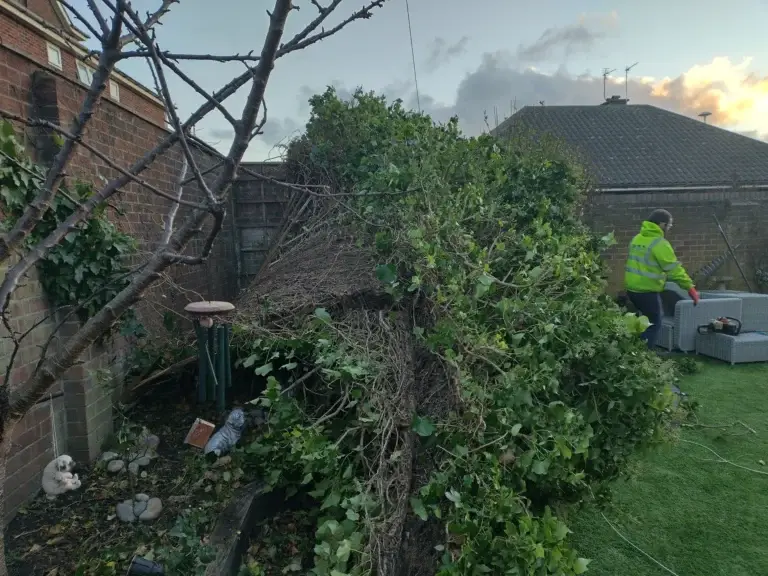
Storms are part of a North East winter, and the question that matters isn’t whether one will hit. It’s who picks up when it does. A down branch over a fire exit or a car park entrance blocked by fallen debris isn’t a job that waits for the next scheduled visit.
We won’t print a guaranteed response time on a blog page. A number typed here commits us to nothing on your site, and you shouldn’t take one from anybody on that basis. Put it in the contract. Asking for it there is exactly right. What’s worth asking alongside it is what happens in the week when every site on a contractor’s books wants the same thing at once, because that’s the week the number gets tested. Tell us what your site actually needs and we’ll say plainly whether we can commit to it.
And whatever the contract says, ask for a name. Who do you actually ring, and does that person answer on a Saturday morning when a branch has come down over the staff car park before anyone’s arrived to open up?
What a winter schedule should say in writing
A winter grounds maintenance schedule earns its place by being specific enough that you can hold someone to it in March. If it just says “winter maintenance included”, you’ve bought nothing you can check. This is the winter half of a wider picture. Our guide on what should actually be in a commercial grounds maintenance contract covers the rest of the year.
Get these four things written down before you sign:
- Visit frequency for the winter half of the year, not just “as required”. Fortnightly can suit a site with mature trees or heavy footfall; a smaller or quieter site might reasonably run to monthly.
- What happens to the arisings. Leaves and cuttings taken away the same visit, or left in a pile at the back of the car park until spring? Ask, because “removed” and “left to rot down” are very different outcomes for a site that’s meant to look managed.
- Photos after each visit. The cheapest, most useful line on the whole schedule. A dated photo record is what you show a tenant, an insurer or your own manager when someone asks whether the site’s actually been looked after.
- One named contact. Not a general enquiries inbox. Someone who knows your site and answers when you ring it.
We work to RAMS on commercial and managed sites, and we’ll complete whatever sign-in or induction your site runs, including site rules and inductions. Ask for that in writing too.
Getting a winter grounds maintenance quote for October to March
We won’t print a blanket winter price here, because a business park, a housing estate and a school site cost different amounts to keep safe, and the honest answer depends on the number of trees, the length of the paths and how often you need us there.
Our grounds maintenance and clearance service covers exactly this, from leaf clearance through to gritting on access routes and car parks when it’s cold enough to matter. We work across business parks, schools, housing estates and industrial sites throughout Sunderland, Washington, Durham and the wider North East, and every visit is backed by full public liability insurance and RAMS documentation you can actually see, not just a line on a website.
If your current contract has gone quiet since the last cut, that’s worth a phone call before it becomes a claim.
Frequently Asked Questions
Does grounds maintenance still need doing over winter?
Yes. Grass stops growing, but leaf fall, standing water, moss and wind damage all continue into the new year, and a site open to staff, tenants or the public still carries the same duty of care it does in summer. A grounds contract that pauses from October to March is leaving exactly the risks that cause slips, trips and blocked access routes unmanaged for half the year.
How often should leaf clearance happen on a commercial site?
It depends on the number and species of trees and how much footfall the site gets, but fortnightly is a reasonable default through the heaviest fall, October to December, dropping back for the rest of winter. A site with mature trees over a car park or main walkway needs a tighter schedule than a quieter site with light planting. Ask your contractor to name the frequency rather than agree to “as required”.
Who is liable if someone slips on leaves at my commercial site?
As the occupier, you owe visitors the common duty of care under section 2(2) of the Occupiers’ Liability Act 1957: reasonable care that they’ll be safe using the site for the purpose they’re there for. Whether a claim succeeds depends on the facts, including whether the hazard was reasonably foreseeable and what you’d done about it. We’re not solicitors and this isn’t legal advice. A documented, scheduled winter maintenance visit is the practical answer, and your insurer or legal adviser can confirm the rest.
Can you guarantee a response time for storm damage?
Not as a blanket promise printed on a website, no. Response times belong in the contract, agreed for your site, and if a guaranteed one is a requirement for you, say so before you sign and we’ll tell you straight whether we can commit to it. What we’ll do either way is turn up for the visits we’ve scheduled and get to reactive jobs as soon as the work in front of us allows.
DB Tree & Garden provides free no-obligation quotes across Sunderland, Washington, Durham, Seaham and the wider North East. We’re fully insured, NPTC and LANTRA qualified, and we’ll send a clear written quote.
Get a free no-obligation quote for a winter grounds maintenance schedule across Sunderland and the North East.