“A tree overhanging my garden” is the kind of thing typed into Google by someone standing at their back door, looking up at next door’s branches, wondering what they’re actually allowed to do about it. Maybe it’s dropping leaves into the guttering every autumn. Maybe it’s scraping the conservatory roof whenever the wind gets up, or blocking the sun off the patio by early afternoon. Before anyone reaches for a saw, there’s an order to work through: what’s actually growing over the fence, whether the tree is protected, what the roots are doing underneath, and whether it’s even the right time of year to touch it. This post goes through that order properly, for gardens across Sunderland, Washington, Durham and the rest of the North East.
TL;DR
- The tree overhanging your garden might be protected. Check for a Tree Preservation Order or a conservation area before anyone touches a saw, on either side of the fence.
- If the tree sits in a conservation area but has no TPO, the council is entitled to six weeks’ written notice before most work, under section 211 of the Town and Country Planning Act 1990.
- Roots count too. Cutting the roots of a protected tree needs the same written consent as cutting its branches, according to gov.uk guidance.
- Between March and September, the RSPB’s main nesting season, check for an active nest before any cutting starts. Taking, damaging or destroying a nest that’s in use or being built is a criminal offence under the Wildlife and Countryside Act 1981.
- If a limb is already touching a conservatory, a wall or a drive, get it assessed properly rather than dealt with off a ladder.
A tree overhanging my garden: where to start
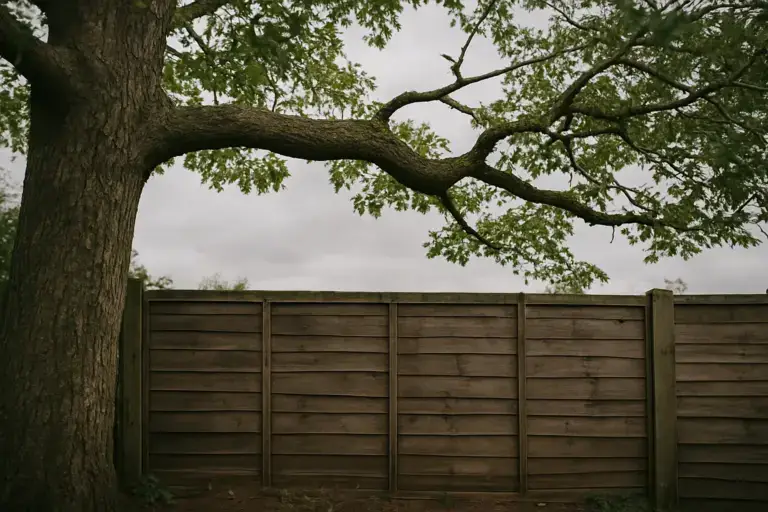
“Tree overhanging my garden” is a search that usually starts with something physical: a branch, or several, crossing the boundary line and hanging over your side, sometimes a few feet in, sometimes most of the crown. The first useful thing to do is split the practical question from the legal one, because online they tend to get answered as if they’re the same thing.
The practical side is what a tree surgeon actually deals with: how big the limb is, what’s underneath it, whether it needs taking down in sections or can come off in one cut, and what kit gets to it safely. The legal side, exactly what you’re entitled to do about growth crossing your boundary and what happens to it once it’s cut, is a property law question. We’re not solicitors, and we won’t pretend to settle that for you here. If you want a definitive answer on where you stand, that’s worth a proper conversation with a solicitor or Citizens Advice rather than a forum thread.
One thing we can say plainly: going into somebody else’s garden without being asked is trespass, whatever the reason for wanting to. That rules out climbing over to deal with cutting back a neighbour’s tree from their side, however close it looks from a ladder on yours.
There’s one check that applies no matter which side of the fence you’re standing on, and it comes before anything else: whether the tree itself is protected. Skip that step and everything that follows, including who’s paying for what, stops mattering.
Check for a TPO or a conservation area before anything else
A Tree Preservation Order protects a specific tree, or a group, in the interests of local amenity. Where one’s in place, the tree’s owner cannot cut it down, top it, lop it, uproot it or wilfully damage it without written consent from the local planning authority first, and that consent can come with conditions attached, under gov.uk’s guidance on Tree Preservation Orders. It doesn’t matter that only part of the crown reaches over your fence. If the trunk belongs to a TPO’d tree, the whole tree is covered, overhanging limb included, however small the section is.
There’s no plaque or paint mark on a protected tree. You cannot tell by looking, and neither can we. Your local council’s planning team holds the TPO and conservation area records (Sunderland City Council, if the tree is in Sunderland or Washington), and it’s worth checking before any work near a boundary. We’ve written more on what a TPO actually covers and what unauthorised work costs in do you need permission to remove a tree.
The conservation area notice, if there’s no TPO
A tree can sit outside a TPO and still be inside a conservation area, and that carries its own rule. Cutting down, topping, lopping or uprooting a tree in a conservation area normally requires six weeks’ written notice to the council first, a section 211 notice under section 211 of the Town and Country Planning Act 1990, so the authority has the chance to consider whether the tree is worth protecting with an Order of its own. There’s a size exemption: a tree whose diameter doesn’t exceed 75 millimetres, measured over the bark at 1.5 metres above ground level, needs no notice at all. Above that, the council can make an Order inside the six weeks, tell you sooner that the work can go ahead, or simply let the six weeks run out, after which the work may be done within two years of the date of the notice.
The council can confirm TPO and conservation area status, so one check answers both questions at once.
Roots are part of this too
Branches get all the attention, but roots are covered by the same Order. Government guidance is explicit that cutting the roots of a protected tree is, in the Secretary of State’s view, a prohibited activity requiring the authority’s consent, the same as cutting its branches. That matters more than it sounds, because roots are the part people are least likely to think of as “the tree” when they’re digging a new patio edge, relaying a shared drive, or putting in a fence post along the boundary.
If there’s any chance the tree overhanging your garden is protected, and its roots run anywhere near work you’re planning on your own side, get that checked at the same time as the branches. It’s one phone call or one site visit either way, and a much cheaper one than finding out afterwards.
Nesting birds, if it’s spring or summer
Under section 1 of the Wildlife and Countryside Act 1981, it’s an offence to intentionally kill, injure or take a wild bird, or to take, damage or destroy its nest while that nest is in use or being built. Worth knowing: some UK advice online quotes a wider version of that wording, with “recklessly” in it. That’s the Scottish text. It doesn’t apply here. An overhanging limb thick with leaf cover is exactly the kind of spot birds nest in, and the offence applies whether the branch is over your boundary or theirs.
The RSPB treats March to September as the main nesting season, and birds can start earlier or finish later than that in some years. If a job needs doing inside that window, the answer isn’t to cancel it, it’s to have someone check the limb for an active nest before any cut goes in.
When the branch is over a conservatory, a drive or a shed
A limb resting on a conservatory roof, scraping glass every time it’s windy, or hanging low enough over a shared drive to catch a high-sided van, isn’t just an inconvenience. It’s a structural risk that needs assessing properly rather than guessed at from the ground.
Even a protected tree has an exception for genuine danger. Where a tree presents an immediate risk of serious harm and work is urgently needed to remove that risk, that work can go ahead without waiting for consent, provided written notice goes to the council as soon as practicable after the work becomes necessary, and the work goes no further than what’s needed to remove the risk. Read the exception carefully, though. Government guidance says there has to be a present serious safety risk, and that if the danger isn’t immediate, the tree doesn’t come within the exception at all. A limb that’s been scraping a roof for two years is a maintenance job, not an emergency.
Rule of thumb: if a limb is already touching a roof, a wall or overhead wires, treat it as a job for a professional, not a weekend one. Height, weight and a shared boundary are exactly the combination that turns a straightforward job into a much more expensive one.
Have the conversation before you book anyone
A lot of this can be sorted at the fence, not in front of a council officer, and it’s an easy step to skip. Knock on and say what you’re actually losing, the light in the back room after lunch, the drive that needs sweeping every week, the roof that needs checking after every gale, rather than a general complaint about how big their tree has got.
If that goes nowhere, put it in writing. Keep it short and specific: what you’d like done, why, and a fair amount of notice, with an offer to help with the cost if that moves things along. It gives the tree’s owner something concrete to agree to, and it’s a record that you tried to sort this reasonably if it ever needs to go further.
When to call a professional
Get someone out to look at it properly if any of this applies: the limb is above what a ladder safely reaches, it’s near a roof, a wall, a drive or overhead cables, you’re not sure whether the tree carries a TPO or sits in a conservation area, or it’s nesting season and you can’t tell from the ground whether anything’s in there. A Sunderland tree surgeon can usually answer the protection question and the safety question on the same visit.
An overhanging limb can often be dealt with by a reduction, taking the limb back to a sound point rather than removing the whole tree, and we explain the difference between a proper reduction and the kind of hacking that shortens a tree’s life in crown reduction vs pollarding vs topping. Because height, access and how many limbs are involved all change the job, we can arrange a site visit to see it before sending a clear written quote. Topping a tree to solve an overhang quickly is rarely a good idea, and the guide linked above explains why.
Our tree surgery and hedge work service covers exactly this: assessing what’s actually overhanging, checking whether it’s protected before we touch a saw, and giving you a straight answer on what the job involves and what it costs.
Frequently Asked Questions
Can I cut a tree overhanging my garden myself?
That depends on things you can’t tell from the ground: whether the tree is protected, how high the limb actually is, and what’s underneath it if it comes down wrong. If it’s small, low enough to reach safely with hand tools, and not protected, it may be a job you can do yourself. Above ladder height is a different job. So is anything near a structure, or any tree where you’re not certain about a TPO or a conservation area, and those are worth looking at properly first rather than fixing afterwards.
Do I have to give the cuttings back to my neighbour?
The usual advice is to offer them back, and it costs nothing to ask. Who legally owns a cut branch is a property law question, and it’s not one we’re going to settle for you here. Either way, waste removal can be part of the quote, so the useful move is asking the tree’s owner what they want doing with the timber before work starts, rather than after.
What if the tree overhanging my garden has a TPO on it?
Then nobody, including the tree’s owner, can cut it down, top it, lop it or uproot it without written consent from the council first, and that includes the part hanging over your side. Doing unauthorised work on a protected tree is a criminal offence. Cutting down or destroying one without consent can lead to a heavy fine. That’s the whole argument for checking first.
How do I find out if a tree is protected?
Your local council’s planning team holds the TPO and conservation area records (Sunderland City Council for Sunderland and Washington), so that is the place to check. We can also help you check permissions before any job starts.
DB Tree & Garden provides free no-obligation quotes across Sunderland, Washington, Durham, Seaham and the wider North East. We’re fully insured, NPTC and LANTRA qualified, and we can help you check whether a tree is protected before any work starts.
Get a free no-obligation quote for local, fully insured tree surgery & garden services across Sunderland and the North East.