A tree that looked perfectly healthy last summer can turn into a genuine hazard in a single wet, windy North-East winter. The tricky part is that most warning signs are quiet. A hairline crack, a bracket of fungus tucked at the base, a lean that crept in over a season — none of them shout for attention until a branch comes down on a car, a fence or, worst of all, someone standing underneath. The good news is that a dangerous tree almost always tells you something is wrong first, if you know what you’re looking at.
Below are seven signs we check on every survey across Sunderland, Durham, Washington, Seaham and Newcastle. For each one you’ll get what it means, roughly how urgent it is, and the point where you should stop poking around and call a qualified arborist. None of this is meant to frighten you — most trees are fine and stay fine for decades. It’s about knowing which handful of symptoms actually matter.
TL;DR
- A sudden new lean, fresh trunk cracks or fungus at the base are the three most urgent red flags — treat them as call-us-now.
- Deadwood, hanging limbs and a thinning canopy are slower burners but still need a professional eye before the next big storm.
- Root heave (soil lifting on one side) often means the tree is already failing at the anchor point.
- Never attempt to fell or dismantle a suspect tree yourself — it’s the leading cause of serious DIY injuries in gardens.
- Check for a Tree Preservation Order before any work; removing a protected tree without consent is a criminal offence.
1. A sudden or worsening lean
Plenty of trees lean a little and always have — that’s usually fine. What matters is change. A tree that has leant the same way for twenty years has adapted its wood and roots to cope. A tree that has developed a new lean over one season, especially after heavy rain or wind, is a different story. The most telling detail is the ground: if the soil on the opposite side to the lean has cracked or lifted, the root plate is starting to tear out.
Urgency: high. A fresh lean over a house, path, road or neighbouring garden should be looked at within days, not weeks. Keep people and pets away from the fall zone until it’s assessed.
2. Cracks and cavities in the trunk
The trunk is the tree’s main structural column, so any splitting there is worth a closer look. Vertical cracks running up the stem, deep splits where two large stems meet, or open cavities where the wood has rotted away all weaken the whole tree. A cavity doesn’t automatically mean removal — mature oaks and sycamores can carry hollows for years — but it depends on how much sound wood is left around the outside.
Watch particularly for included bark, where two stems have grown so tightly together that bark is trapped in the join. That union is far weaker than it looks and is a classic failure point in storms.
Urgency: medium to high depending on size and location. A fresh, widening crack in a large stem is urgent.
3. Fungus or brackets at the base
Mushrooms and shelf-like brackets growing on the trunk or around the roots are one of the signs we take most seriously. They’re the fruiting body of a fungus that is often decaying the wood inside — the part you can’t see. Bracket fungi around the base or on the buttress roots can indicate root and butt rot, which quietly hollows out exactly the section holding the tree upright.
A single small mushroom in the lawn nearby is usually nothing. Persistent brackets fixed to the bark, or a ring of them at the base, deserve a proper diagnosis because the outside can still look green and full while the anchor rots.
A note on timing. Fungal brackets are easiest to spot in autumn and after damp spells — exactly when North-East gardens get plenty of both. If you find one, photograph it and note where it’s attached before you call; it helps us identify the species and the risk.
4. Deadwood and hanging limbs
Bare branches with no leaves in the growing season, brittle limbs that snap rather than bend, and branches already broken but caught in the canopy — often called hangers or widow-makers — are all straightforward hazards. Deadwood will eventually fall; the only question is when and onto what.
Small deadwood high up over a quiet corner of the garden is low priority. A large dead limb over a patio, driveway, trampoline or public footpath is not. This is one of the most common reasons homeowners around Washington and Seaham call us in, and it’s usually a clean, quick job for a climber with the right kit. It’s also the sort of work where bad pruning makes things worse — see our guide to the tree pruning mistakes to avoid before anyone reaches for a saw.
Urgency: medium — but high for anything large sitting over a target.
5. Root heave and lifting soil
The roots do the anchoring, so trouble down there is trouble everywhere. Signs to look for: soil that’s cracked or humped on one side of the base, roots that appear cut or damaged (common after building work, a new drive or a trench), and mushrooms following the line of the roots. A tree that seems to be gently rising out of the ground on the windward side is a serious warning that the root plate is lifting.
Root damage often shows up a season or two after the event, so if you’ve had groundworks, drainage or an extension near a mature tree, keep an eye on it. Once the anchor is compromised, the canopy above becomes a large sail waiting for the wrong gust.
Urgency: high if the soil is actively lifting.
6. A thinning or bare canopy
Compare your tree to others of the same species nearby. If everything else has leafed up fully and yours is sparse, patchy or dying back from the tips, the tree is under stress — from disease, drought, root damage or old age. Dieback rarely means immediate collapse on its own, but a declining tree drops limbs more readily and is worth monitoring closely.
One thin year after a hard summer can be normal. A tree that thins a little more each season is trending the wrong way and should be assessed before decline becomes danger.
Urgency: low to medium — book a survey rather than an emergency call.
7. Fresh storm damage
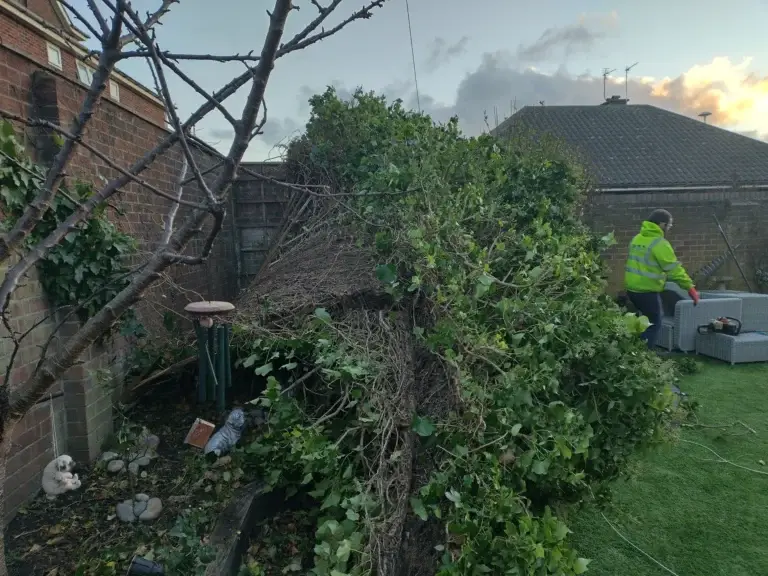
After a big blow — and we get our share coming in off the coast — walk the garden and look up. Torn limbs, a split fork, a partially uprooted trunk or a large branch lodged in the crown all need dealing with promptly. Storm-damaged trees are unpredictable: a limb under tension can release without warning, which is exactly why storm clear-up injures so many people who try to tackle it themselves.
Urgency: high. If anything is leaning on a structure or power line, keep everyone clear and call a professional immediately. Never touch anything near overhead cables.
When to stop and call a tree surgeon
Here’s the honest line we hold with every customer: inspecting a tree from the ground is something any homeowner can do. Fixing a dangerous one is not. Felling, dismantling a compromised trunk or working at height with a chainsaw is genuinely hazardous work — it’s a leading cause of serious garden and DIY injuries, and a stressed tree behaves in ways that catch even experienced people out. If you’ve spotted any of the high-urgency signs above, the safe move is to keep clear and get a qualified, insured arborist to assess it.
A proper assessment tells you what’s actually wrong, whether the tree can be saved with pruning or crown work, and what it’ll cost — no scare tactics. If you’re weighing up quotes, our guide on how to choose a tree surgeon in Sunderland walks through the qualifications and insurance to look for.
One more thing before any work starts: many mature trees are protected by a Tree Preservation Order, and some sit in conservation areas where similar rules apply. Removing or heavily pruning a protected tree without council consent is a criminal offence, even if the tree is dead or dangerous — you usually still need to notify the council first. We handle these checks as standard, and you can read more in our guide on getting permission to remove a tree.
Worried about a tree? Let’s take a look
If any of these signs sound familiar, don’t sit on it through another storm. As a fully insured, family-run team with qualified arborists and 40-plus years of combined experience across Sunderland, Durham, Washington, Seaham and Newcastle, we’ll give you a straight answer and a free, no-pressure quote — whether that’s a simple deadwood trim, dead tree removal or a full survey. Call the Sunderland office or request your free quote online today, and we’ll get a qualified eye on it.