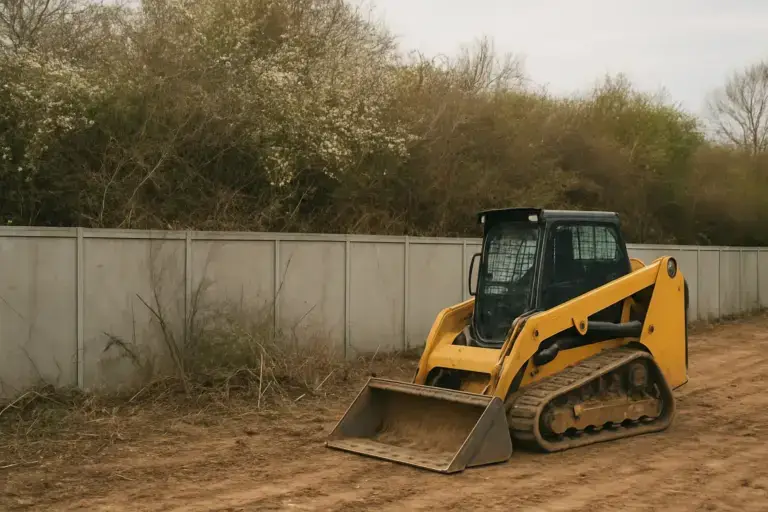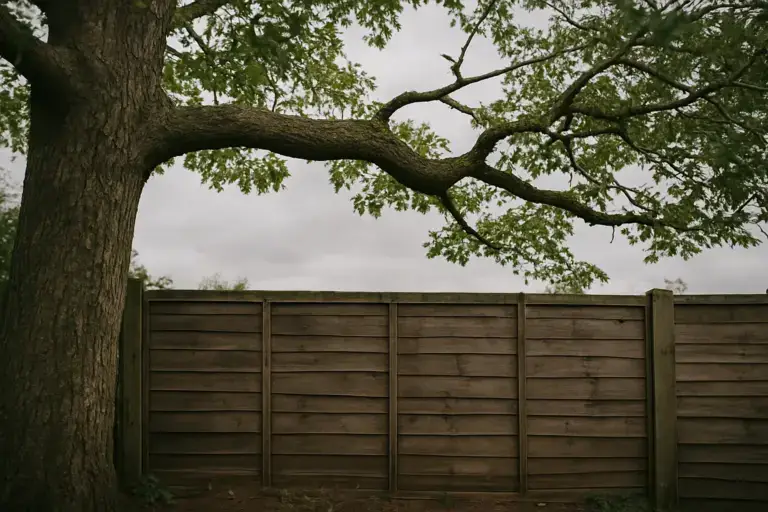
You’ve got a start date pencilled in, a groundworks contractor booked in behind it, and a plot that’s been left three years past its last cut. Clearing overgrown land sounds like the easy bit before the real work starts: a couple of days with a mower and a chainsaw so the diggers can move in. It can be exactly that simple. It can also be the reason your programme slips, because nobody checked what was living in the scrub before the first cut went in. This is for developers, contractors, land agents and landowners pricing a clearance with a deadline sitting behind it. Five things stop a site dead, and every one of them is a phone call before you fix a date, not an afternoon with a chainsaw after it’s booked.
TL;DR
- Nesting birds, bats, badger setts, protected trees and buried waste can each halt a clearance the moment they’re found, and checking for all five before you start costs far less than losing time mid-job.
- Scrub or hedgerow clearance in the nesting season needs checking first, because the Wildlife and Countryside Act 1981 protects a nest in use or being built.
- Mature trees, outbuildings and barns on site can hold a bat roost, which is protected at any time of year, not just in summer.
- A Tree Preservation Order or a conservation area over the site means either the council’s written consent, or six weeks’ notice to the council, before any tree work starts.
- Japanese knotweed needs a specialist. If it turns up during a survey or mid-clearance, leave that patch alone until it has been identified.
One: nesting birds and why clearing overgrown land waits for the right season
Scrub, bramble and hedgerow are exactly where birds nest, and cutting through an active nest is an offence under section 1 of the Wildlife and Countryside Act 1981. In England it’s a crime to intentionally kill, injure or take a wild bird, or to intentionally take, damage or destroy its nest while that nest is in use or being built. There’s no shortlist of species this applies to. It covers a wren tucked into a bramble tangle just as much as a blackbird in a hawthorn hedge.
If your clearance date lands in the nesting season, we check the scrub and hedgerow line before cutting starts, not after. If a nest turns up mid-cut, that section stops until the nest is no longer in use, which on a tight programme is the expensive way to find out something a site walk would have flagged for free.
Cutting outside the season, or clearing a site that’s already been checked and confirmed clear, lowers the risk. It’s the cheapest of the five to plan around, and the one that can catch out scrub clearance jobs, because the felling date gets fixed around groundworks, not around what’s nesting in the hedge line. We’ve covered the timing rules and boundary points in more detail in hedge cutting and the law.
Two: bats roosting in mature trees, outbuildings and barns
Bats are a European protected species, and regulation 43 of the Conservation of Habitats and Species Regulations 2017 makes it an offence to deliberately capture, injure or kill one, to deliberately disturb one, or to damage or destroy its breeding site or resting place, known as its roost, at any time of year. A roost stays protected even when it’s empty on the day you visit.
On a clearance site the places that matter are mature trees with cracks, loose bark, cavities or old woodpecker holes, plus any outbuilding, barn or structure due to come down that has hanging tiles, uneven roof tiles or large roof timbers. A single veteran tree on the boundary line of an otherwise scrubby plot changes the picture completely.
Where a site has mature trees or structures that fit that description, it’s worth flagging before a start date is fixed. A suspected roost usually means a professional bat survey before that particular tree or building can be touched, and that’s a specialist instruction, not something a groundworks crew can self-certify on site.
Three: badger setts on overgrown sites
Badger setts can turn up on overgrown sites wherever there’s suitable ground for sett building. Section 3 of the Protection of Badgers Act 1992 makes it an offence to interfere with a sett: damaging it, destroying it, obstructing an entrance, or disturbing a badger that’s occupying it, whether that’s done intentionally or recklessly.
A sett isn’t always obvious under bramble and long grass. A first pass with a brushcutter can flatten whatever was there, which is exactly why the check happens before the cutting starts rather than during it.
If a sett is confirmed active, that ground needs to be excluded from the clearance, and any work that needs to go closer runs through Natural England. On a development programme, that’s the difference between a small exclusion zone marked out in week one and a halt once a digger’s already on the embankment.
Four: protected trees, conservation areas and the six-week notice
Two separate protections can sit over a site, and they work differently. A Tree Preservation Order protects a named tree or group of trees specifically, and work to a tree under a TPO needs the council’s written consent before anything happens to it. A conservation area works the other way round: every tree inside the boundary that isn’t already covered by a TPO gets a baseline protection, and section 211 of the Town and Country Planning Act 1990 requires six weeks’ notice to the council before work on it starts. A few exemptions apply, including one for very small trees; the council will tell you if any covers yours.
That six-week window isn’t paperwork for its own sake. It gives the council time to decide whether the tree’s worth a TPO of its own; if they think it is, they can make one inside that window, and then it’s consent you need rather than just notice. Skip the notice and go ahead anyway, and it’s an offence under the same Act, regardless of whether the council would ever have acted on it. For land clearance for developers working to a fixed access date, that six-week window needs building into the programme from day one, not discovered on a site visit in week two.
Either way, this is a council conversation, not ours to settle. Sunderland City Council, or the equivalent planning authority for the site, holds the TPO and conservation area records, and it’s worth checking with them before you fix a felling date. Checking after a crew’s cut into a protected tree is where the fines start, and there’s no ceiling on them. Section 210 of the same Act was amended in 2015: cutting down or wilfully destroying a protected tree now carries an unlimited fine, magistrates’ court or Crown Court. You’ll still see the old cap quoted, including on government guidance that hasn’t been revised since 2014. It isn’t the figure a court works to any more.
Five: what’s actually under the vegetation
Once the green stuff’s gone, what’s underneath it is the next surprise. Overgrown land that’s sat untouched for years can hide fly-tipped waste: builders’ rubble, old fencing, tyres, even asbestos cement roofing sheets, dumped and grown over until you’d never know it was there. Clearing overgrown land can mean clearing somebody else’s dumped rubbish along with it, and that’s a different job to price than a straightforward scrub cut.
Asbestos changes the job the moment it’s confirmed. The Health and Safety Executive is clear that anyone who unexpectedly comes across suspected asbestos-containing material during work should stop and get it identified before continuing, and the higher-risk materials need a licensed contractor rather than a general clearance crew. Nobody should guess at that call. If sheeting looks like it could be asbestos cement, work in that spot should stop until it’s been identified properly.
Ordinary fly-tipped waste is more straightforward but still carries obligations. Anyone producing or keeping waste from a commercial site has a duty of care to use a registered waste carrier and keep a transfer note for each load that leaves. It’s worth asking any contractor whether they do, because the duty falls on whoever produces or keeps the waste, not just whoever’s driving the tipper.
Rule of thumb: a pre-start check for nesting birds, roosts, setts, protected trees and buried waste on a scrub or land clearance takes far less time than a stoppage mid-job. Standing a clearance crew down mid-job because one of those turns up unchecked can put the programme back, and on a fixed programme it’s your access date that absorbs it.
Japanese knotweed needs a specialist
Bramble, dense scrub and overgrowth, that’s all normal ground for us. Japanese knotweed is different, and it needs a specialist.
It isn’t illegal to have knotweed on your land, and there’s no legal duty to remove it unless it’s causing a nuisance, but causing it to spread into the wild is an offence, and soil or plant material contaminated with it can be classed as controlled waste that has to go to a landfill or incineration site with the right permit, carried there by a registered waste carrier. A mower or a digger bucket that’s been through an infested patch is exactly how it ends up spread across the rest of the site, or off it entirely and onto the next one.
So if we find it during a survey, or it turns up mid-clearance, that area should be kept separate from the rest of the work and left for a specialist to identify and treat, rather than cut through. It’s slower in the short term, but cutting through it is how it spreads.
Get a clear commercial quote before you fix a start date
The pattern is the same across every one of them. Cheap to check for, expensive to discover once a crew’s on site and the clock’s running. That’s what a proper site clearance survey settles before you commit to a start date, and it’s why clearing overgrown land on a programme deadline starts with a phone call, not a chainsaw. It tells you which of these apply to your plot, if any, and lets you build the right sequence: ecology and tree checks first, then the clearance itself, then groundworks moving in behind it on the date you actually promised.
We’ll walk the site, tell you plainly what we can see and what needs a specialist look, and put a written commercial quote together that reflects the real site rather than a guess from a satellite photo. Where the job needs more than hand tools, our operated machinery hire comes with trained operators, and larger or awkward sites are covered under large-scale site clearance. If it helps to see the shape of a finished job first, we’ve also written up what a day on a commercial grounds clearance actually involves. Wherever the site sits, the sequence that works is check first, quote honestly, then clear.
Frequently Asked Questions
How long does a pre-clearance ecology and tree check add to the programme?
The checks cover nest activity in the scrub and hedgerow line, signs of a bat roost in any mature tree or building due to come down, badger sett entrances, and whether a TPO or conservation area covers the plot. How long they add depends on the site, and they are best done before a start date is fixed.
What happens if nesting birds are found once clearing overgrown land has already started?
The section with the active nest stops. Under the Wildlife and Countryside Act 1981 it’s an offence to intentionally damage or destroy a nest while it’s in use, so we exclude that patch and carry on with the rest of the site where it’s safe to. That section waits until the nest is no longer in use, rather than holding the whole job up.
Do you offer Japanese knotweed treatment as part of a clearance?
Please ask us about it before you book. Knotweed needs specialist identification and treatment, and cutting or digging through it is how it spreads, so it shouldn’t be treated like a normal patch of scrub.
Who is responsible if fly-tipped waste or asbestos turns up during clearance?
The duty of care for waste leaving a site sits with whoever produces or keeps it, which is why it’s worth asking any contractor about registered carriers and waste transfer notes. If material looks like it could contain asbestos, work in that spot should stop and the material be identified before anything’s disturbed.
Does a small residential plot need the same checks as a large development site?
The checks themselves don’t change with size. Nesting birds, roosts and setts don’t care how big the plot is. The same checks apply either way; it just takes less time to walk a smaller plot.
DB Tree & Garden provides free no-obligation quotes across Sunderland, Washington, Durham, Seaham and the wider North East. We’re fully insured, NPTC and LANTRA qualified, and we’ll send a clear written quote after a site visit.
Get a free no-obligation quote for local, fully insured tree surgery & garden services across Sunderland and the North East.