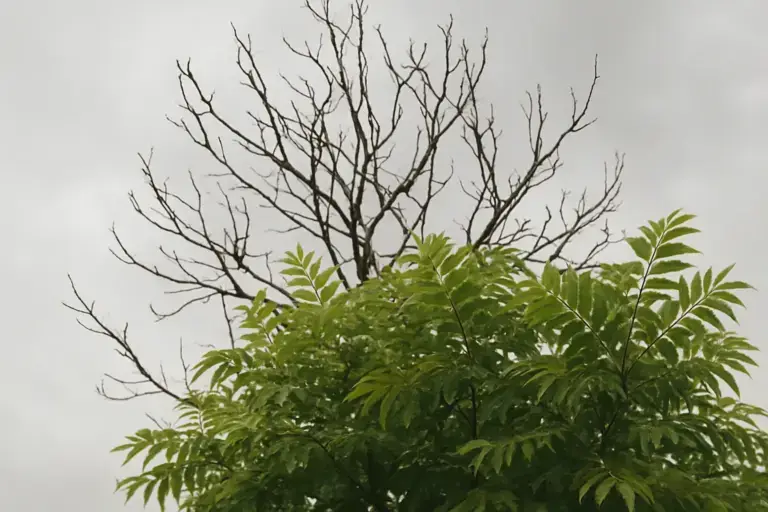
That ash at the bottom of the garden has looked thin on top for two summers running. It’s not obviously dead and it’s not obviously fine, and you’ve heard the words ash dieback mentioned often enough on the news, or by a neighbour, to wonder if that’s what you’re looking at. It’s present in most parts of the UK now, recorded in every county, so Sunderland, Washington, Durham and the rest of the North East are no exception. That doesn’t mean your ash has it. Once you know what to look for, the difference between a tree having a bad year and a tree that’s genuinely declining is usually visible from the ground. Here’s how to tell which one you’ve got, and what actually changes once an ash is infected.
TL;DR
- Caused by the fungus Hymenoscyphus fraxineus, it’s present across most of the UK. Check the tree is actually an ash before you assume the worst.
- Look for blackened, wilting leaves in mid to late summer, and dark, diamond-shaped lesions where a branch or shoot meets the stem.
- A dead or dying ash is a risk to the people working on it, which changes how it’s safely worked on, not just whether it needs to come down.
- There’s no cure, and the general advice is against felling every infected ash. Some tolerate it or recover.
- An ash over a footpath, road, parked cars or a neighbour’s roof is a different conversation to one at the bottom of a long garden.
Check it’s actually an ash first
Before anything else, look at the tree itself. If you’re not sure it’s an ash, get that settled first, because ash dieback isn’t the question you need answering if it isn’t one.
A late leaf flush isn’t dieback
Ash is also one of the last trees in the North East to come into leaf. It’s genuinely normal for a healthy ash to sit bare into April, or even May on a colder site, because ash trees flush at different times depending on their genetics, and trees further north flush later. A bare ash in April tells you nothing on its own. By mid-June, though, every healthy ash should be in full leaf, so a crown that’s still sparse then is worth a proper look.
What ash dieback looks like on the tree
The disease is caused by a fungus, Hymenoscyphus fraxineus, and on a real tree it shows up in a fairly consistent order. The signs below are the ones Forest Research, Great Britain’s principal organisation for forestry and tree-related research, and the Forestry Commission document, and they’re all things you can check from the ground without laying a hand on the tree. None on its own is conclusive. Together they build a clear picture:
- Blackened, wilting leaves and shoots in mid to late summer. July to September is the easiest window to spot this, before the tree’s own autumn colour change gets mistaken for it.
- Dark, diamond-shaped lesions at the joints. Where a side shoot or smaller branch meets a bigger one, look for elongated cankers in the bark. They typically spread up and down from the joint.
- Leaf loss and dead branches through the crown. Lesions can girdle twigs and branches, and the result is leaf loss and dead branches throughout the crown. A crown that’s noticeably sparser than it was, two seasons in a row, is the pattern that matters.
- Clumps of new growth towards the centre of the crown. The Forestry Commission lists these alongside the leaf loss, and on an ash that’s already thinning, they fit the same picture.
If you want to weigh what you’re seeing against the wider picture of a struggling tree, not just an ash specifically, our guide to the eight signs a tree is dying covers the general signs alongside what’s specific here.
Why a declining ash isn’t like other dying trees
Many dying trees fail slowly and, to an extent, predictably. A tree with dieback doesn’t play by the same rules. The fungus doesn’t just kill leaves, it attacks the bark and girdles twigs and branches, and older ash trees can hold on for some time before another pest or pathogen, such as Armillaria, or honey fungus, moves into the weakened tree and finishes the job. Dead or dying ash also poses a risk to the people working on or near it.
That changes how a tree like this is worked on. Basal lesions, cankers low on the trunk, matter because those weaken the base and raise the chance of whole-tree failure rather than just a branch coming down. It also changes the plan for taking the tree down. A sound tree can often be climbed and dismantled piece by piece from the ground up. A dieback-affected one is a different judgement call: depending on the tree, it can change how the tree is accessed and the rigging plan. Which is right depends on what’s actually in front of us, not a description over the phone. If you want the wider checklist for when any tree, not just an ash, has crossed from worth watching into worth assessing, our guide to the seven signs a tree is dangerous covers it.
When it stops being just a garden question
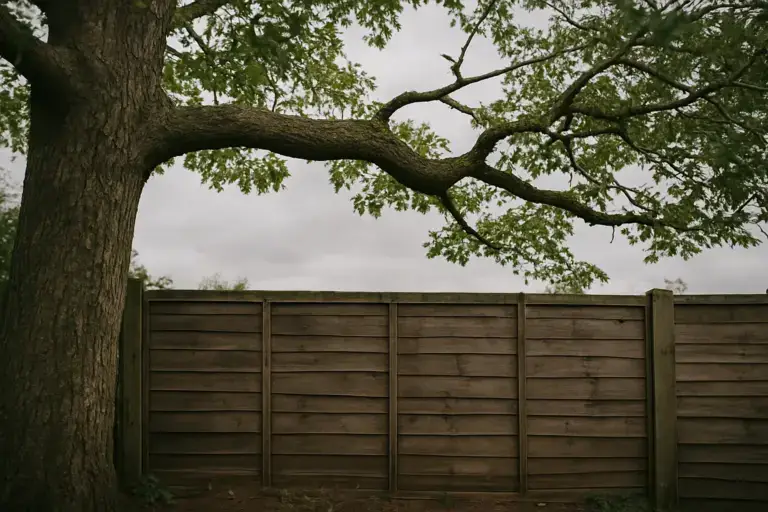
An ash quietly declining at the back of a long garden, nowhere near a path, a road or a building, is mostly a question of keeping an eye on it. The same tree leaning over a footpath, a driveway, parked cars, a shared boundary or a neighbour’s roof is a different situation, because now its condition affects people and property that aren’t yours.
Two different things are going on there, and they’re worth keeping apart. For people you let onto your own land, the Occupiers’ Liability Act 1957 sets the common duty of care: taking such care as is reasonable in the circumstances to see that a visitor will be reasonably safe using the premises. That includes anyone you’ve invited round. It doesn’t reach a car parked on the street or next door’s roof. Harm beyond your own boundary runs on a different legal route, and which one depends on facts nobody can judge from a photo. So we won’t tell you what you’re liable for, and you shouldn’t take that from a tree surgeon anyway. Ask your insurer. What we will do is say plainly when a tree’s condition has moved from worth watching to worth acting on.
If the ash is protected, by a Tree Preservation Order or because it stands in a conservation area, that protection doesn’t lapse just because the tree is ill. Government planning guidance is blunt about it: consent is needed for work on diseased or dying trees unless some other exemption applies, and the usual exemption is work urgently necessary to remove an immediate risk of serious harm. Being ill isn’t the same as being dangerous. Our guide to getting permission to remove a tree in Sunderland covers how that works, and Sunderland City Council’s planning team is the right place to check a specific tree.
Rule of thumb: if the ash is nowhere near anything it could hit, a bit of patience and an annual check is often the right call. If it’s over a path, a road, parked cars or a roof, and the top’s been thinning for more than one season, get it looked at in person rather than judging it from the ground.
No cure, and not every infected ash needs to come down
There’s no known cure for it. Some fungicides might suppress it, but they need repeating, perhaps every year, and they’re aimed at trees of particular value rather than a typical garden ash. The wider advice leans against felling living ash trees just because they’re infected, because a small number tolerate the fungus or even recover, and those individual trees matter for the species’ future. Felling every infected tree on sight would remove exactly the ones worth keeping an eye on.
That’s the honest position, and it means we won’t tell you a declining ash has to come down before we’ve actually looked at it. What we will do is assess the tree on its own merits: how advanced things are, what’s around it, whether the crown loss is stable or worsening, and whether monitoring, a reduction, or removal is the right call. Not every thin-topped ash in Sunderland, Washington or Durham is a felling job. Plenty just need watching.
Reporting a case of ash dieback
It’s listed by Forest Research as a reportable disease. If you’d like to log a suspected case, Forest Research’s TreeAlert tool takes photos of the tree, how the symptoms are spread across it and a close-up, plus an accurate location such as a grid reference.
Forest Research’s page sets out when an owner has to act on an infected ash, so check it before acting. Its own advice is that public safety must be the priority.
Getting a declining ash looked at properly
If your ash ticks more than one of the signs above, especially if it’s anywhere near a path, a drive, a road, parked cars or next door’s roof, the next step is a site visit rather than more guessing from a photo. We’ll look at the crown, check the trunk and lower stem for lesions, and give you a straight answer on whether it’s a watch-and-wait tree, a candidate for reduction, or one that needs to come down.
For a dying ash, we’ll arrange a site visit and then send a clear written quote. A declining tree can change what equipment and access the job needs, and that’s what sets the number. Our Sunderland tree removal price guide covers what drives the cost, but where a particular ash lands depends on the tree in front of us. This falls under our tree surgery and hedge work across Sunderland, Washington, Durham, Seaham and the wider North East.
Frequently Asked Questions
Is ash dieback actually in the Sunderland area?
Yes. It’s present in most parts of the UK, and the North East isn’t an exception, though how far it’s progressed varies from tree to tree and street to street. That’s exactly why the actual symptoms on your tree matter more than a general assumption either way. One neighbour’s ash having it doesn’t mean yours does, and a healthy-looking ash two doors down doesn’t rule it out for yours either.
My ash still has healthy leaves lower down. Does that mean it’s fine?
Not necessarily. Infection leads to leaf loss and dead branches through the crown, so healthy leaves on some branches don’t mean the tree’s in the clear. A bare canopy that fills back in properly by mid-June, on the other hand, can just be a late flush, which is completely normal for ash.
Do I have to report a case of ash dieback?
It’s listed by Forest Research as a reportable disease, and its page sets out when an owner has to act, so check that before acting. If you’d like to log a case, TreeAlert takes photos and a location.
Will an infected ash definitely need to come down?
Not always. There’s no cure, but the wider advice leans against felling every infected ash, because a small number tolerate the fungus or recover, and those trees matter for the species. Where the tree stands changes the answer: one well away from anything it could hit is often fine to monitor, while one over a path, a road, parked cars or a roof needs a proper look sooner rather than later.
How much does it cost to remove a dying ash tree?
It depends on the tree, and we won’t quote one without seeing it. Tree removal is priced on the size of the tree, access and what’s around it, and a dieback-affected ash can need different equipment or access than a healthy tree the same size, and that’s what actually sets the number after a visit.
DB Tree & Garden provides free no-obligation quotes across Sunderland, Washington, Durham, Seaham and the wider North East. We’re fully insured, NPTC and LANTRA qualified, and we’ll send a clear written quote.
Get a free no-obligation quote for local, fully insured tree surgery & garden services across Sunderland and the North East.